Swing Trading vs Day Trading: Which One Should a Beginner Choose?
New to trading? A clear, beginner-friendly breakdown of swing trading vs day trading, and the math behind why most beginners should start with swing trading.
Educational content only. Nothing on this page is financial or investment advice. Full disclaimer
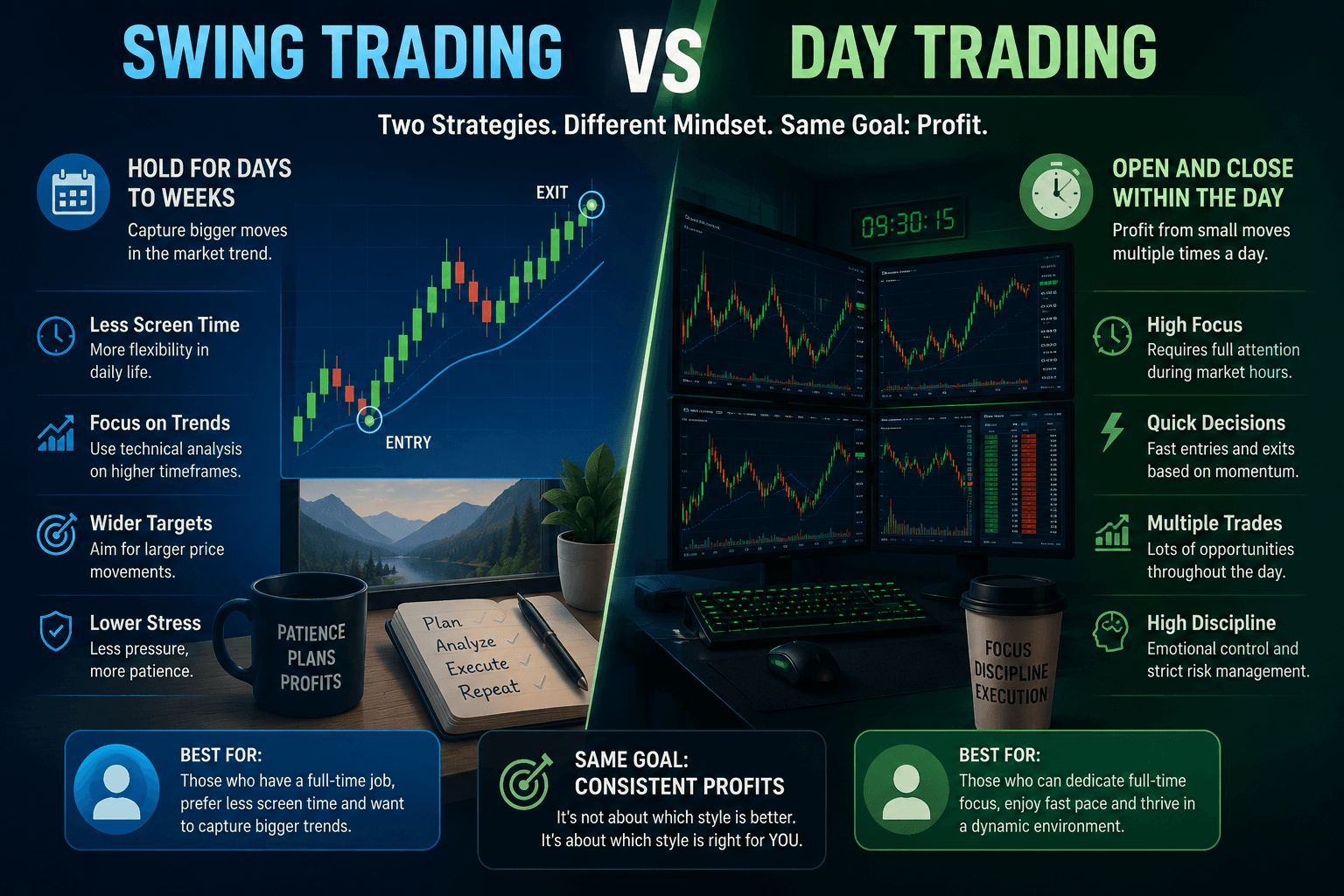
If you are new to trading, the first real decision you face is not which stock or coin to buy. It is how often you trade. That single choice shapes your costs, your stress levels, your learning curve, and ultimately whether your account grows or bleeds out.
The two most popular styles are day trading and swing trading. This guide explains both in plain language, then shows you, with real math, why swing trading is the smarter starting point for most beginners.
The two styles in one minute
Day trading means opening and closing positions within the same day. Day traders take many trades, often three to ten per day, trying to profit from small intraday moves. Nothing is held overnight.
Swing trading means holding positions for several days to several weeks, riding a single larger move (a "swing") in the market. Swing traders take far fewer trades, often just a handful per month, and read charts on daily and weekly timeframes.
Same markets, same charts, completely different lifestyle and completely different math.
Advantage 1: trading costs stay small
Every trade you take costs you something: commissions, the bid-ask spread, and slippage. Each one looks tiny in isolation, often around 0.1% per round trip. But costs compound against you the same way gains compound for you.
A day trader taking 3 trades a day pays that toll roughly 63 times per month. A swing trader taking 6 trades a month pays it 6 times. Over a year, the difference is not small. It is the difference between keeping your capital and losing almost half of it before the market has even moved.
What trading costs alone do to a $10,000 account
Account value after fees, spread and slippage, before any market gains or losses
Swing trading (6 trades/month)
Day trading (3 trades/day)
Assumptions: $10,000 starting account, 0.1% total cost per round trip (commission + spread + slippage), 21 trading days per month. Day trading: 3 round trips per day. Swing trading: 6 round trips per month. Costs compound; no market gains or losses included.
Read that again: before the day trader has made a single good or bad call, the cost structure alone has taken nearly half the account. The swing trader gave up about 7%. That is the head start swing trading hands you on day one.
| After | Swing trading | Day trading |
|---|---|---|
| 3 months | $9,822 | $8,277 |
| 6 months | $9,646 | $6,851 |
| 12 months | $9,305 | $4,694 |
Advantage 2: you can keep your job and your life
Day trading is a full-time occupation. You are glued to the screen from the opening bell, because the moves you trade last minutes. Miss an hour and you miss your setups, or worse, you leave a position unattended.
Swing trading fits around a normal life. Your analysis happens on daily and weekly charts, which only "close" once a day or once a week. Thirty to sixty minutes in the evening is enough to review positions, set alerts, and place orders. Your stop loss and take profit work for you while you are at your job, at the gym, or asleep.
For a beginner, this matters twice over: you keep your income while you learn, and your trading capital is savings you can afford to grow slowly instead of rent money you need to win back by Friday.
Advantage 3: fewer decisions, fewer emotional mistakes
Every trade is a decision made under pressure, and beginners make their worst mistakes under pressure: revenge trading after a loss, cutting winners too early, doubling down on losers.
A day trader makes dozens of these high-pressure decisions every single day, with seconds to think. A swing trader makes a few per month, with hours or days to think. Same human brain, wildly different error rate.
Lower timeframes are also noisier. A 5-minute chart is full of random wiggles that look like signals. Daily and weekly charts filter that noise out, so the trends you trade are real trends. This is exactly why our approach at Masari Cabal is built on higher timeframe swing analysis: the bigger the timeframe, the cleaner the signal.
Advantage 4: a learning curve you can actually survive
Trading skill is built by taking trades, journaling them, and reviewing what happened. The catch: you have to still have an account left by the time the lessons sink in.
Day trading compresses hundreds of trades, and hundreds of chances to blow up, into your first weeks. Swing trading stretches the same lessons over months while costs and mistakes stay small. You get the full cycle of planning a trade, sitting through the drawdown, and taking profit, at a pace where you can actually reflect between trades.
Advantage 5: it protects the thing that matters most, your capital
The math of losses is brutal and asymmetric. Lose 50% and you need a 100% gain just to get back to break even. A blown account cannot compound at all.
Swing trading, done with proper position sizing and stop losses, keeps drawdowns survivable. That keeps you in the game long enough for compounding to work, and compounding is where real capital growth comes from. Not from one heroic day at the screen, but from months of stacked, unspectacular wins.
Side by side
| Swing trading | Day trading | |
|---|---|---|
| Holding period | Days to weeks | Minutes to hours |
| Trades per month | ~5 to 15 | ~60 to 200+ |
| Time needed | 30 to 60 min/day | Full time |
| Cost drag per year | Low | Very high |
| Stress level | Moderate | Extreme |
| Works with a day job | Yes | No |
| Account size to matter | Start small and grow | Multiple 6 figures for real income |
| Beginner friendly | Yes | No |
The account size problem nobody tells beginners
Here is the part most trading influencers skip: even if you become a good day trader, the income math does not work on a small account.
Say you want day trading to replace a modest $60,000 salary. An elite full time trader might pull 20 to 30% out of the market in a year, and that is a generous assumption. To turn 30% into $60,000, you need a $200,000 account. On a $5,000 account, that same elite performance pays $1,500 for a full year of screen time. Less than a weekend job, with far more stress.
The barriers are structural, not just mathematical:
- You need serious capital before you start. In the US, the pattern day trader rule already requires a $25,000 minimum just to day trade stocks freely, and that is nowhere near enough to live on.
- Small accounts force oversized risk. To make meaningful money on $5,000, you have to risk a huge share of it per trade, which is exactly how accounts blow up.
- Living costs force bad trades. When rent depends on this week's trades, you take setups you should skip. Pressure to earn is the enemy of good trading.
In practice, day trading only becomes a realistic income source with a multiple six figure account. That leads to the obvious question: how do you get one?
Not by day trading a small account. You get there by growing capital patiently, and that is exactly what swing trading is built for. Fewer trades, lower costs, survivable drawdowns, and time for compounding to do the heavy lifting while your salary keeps funding your life. Swing trading is the bridge: grow your account to multiple six figures first, and only then does day trading even become a rational option to consider.
Is day trading ever the right choice?
To be fair: yes, for a small group. Experienced traders with proven systems, fast execution, low fee structures, full time availability, and a large enough account can make day trading work. Some do very well.
But that is the destination, not the starting point. Almost every study of retail day traders finds that the large majority lose money, and cost drag like the chart above is a big part of why. If you master swing trading first and build your capital, you can always speed up later. Going the other direction usually means rebuilding a blown account.
How to start swing trading in 5 steps
- Start with capital you can afford to lose. This is tuition money for your education, not next month's rent.
- Trade the daily and weekly charts. Higher timeframes filter out noise and give you time to think.
- Risk a fixed, small percentage per trade. 1 to 2% of your account per position is the classic rule. Position sizing is your first and last line of defense.
- Always set your stop loss before you enter. Decide where you are wrong while you are calm, not while the candle is moving.
- Journal every trade. Entry, exit, reason, emotion. Your journal will teach you more than any influencer will.
The bottom line
Day trading looks exciting, and that is exactly the problem: excitement is expensive. Swing trading gives a beginner lower costs, fewer emotional mistakes, a survivable learning curve, and a schedule that fits real life. It optimizes for the only thing that matters in your first years: staying in the game while your skill and your capital compound.
Think of it as a sequence, not a rivalry. Swing trade to grow your account toward multiple six figures. Once you are there, day trading becomes a choice instead of a gamble, and you may find you no longer want it anyway.
If you want to see this philosophy applied in real time, take a look at the Midas Index and follow how we track higher timeframe swings across the market.
This article is for educational purposes only and is not financial advice.