The Software vs. AI De-Rating May Be Behind Us
Software stocks stopped selling off on bad AI headlines. Why the market shrugging at the latest Anthropic news might signal a rotation into software equities.
Educational content only. Nothing on this page is financial or investment advice. Full disclaimer
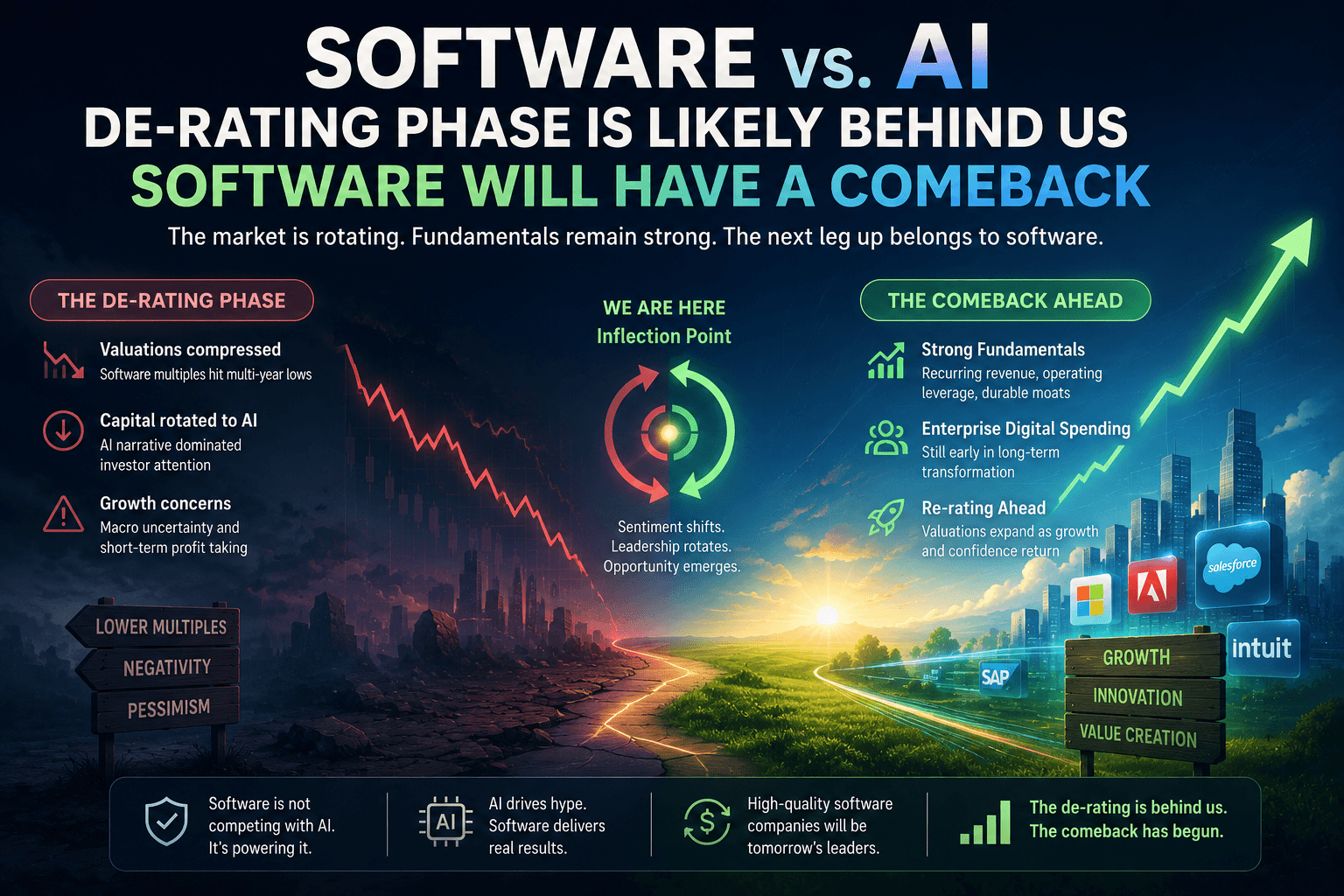
For the past year, one trade has punished software investors over and over: every major AI model release triggered a wave of selling across the software complex. The logic was simple and brutal. If frontier AI models can write, plan, and execute software tasks, why pay premium multiples for the companies that sell software?
That repricing was real, and in many cases justified. But markets do not de-rate forever. At some point the bad news gets priced in, sellers get exhausted, and the tape starts telling you something different. I think we may have just seen that moment.
The setup: another AI headline that should have hurt
The recent news flow was, on paper, exactly the kind that crushed software names in prior cycles:
- Anthropic released its latest frontier model, another step up in capability from an already dominant lab.
- The U.S. lifted restrictions on Fable, opening the door to broader deployment of the model.
Twelve months ago, either of those headlines alone would have been worth several percent of downside in software indices within days. The playbook was automatic: AI capability up, software multiples down.
This time, the playbook did not run.
What actually happened: the tape ignored the news
Look at the daily chart of IGV, the iShares Expanded Tech-Software Sector ETF, which is the cleanest single proxy for the software complex.
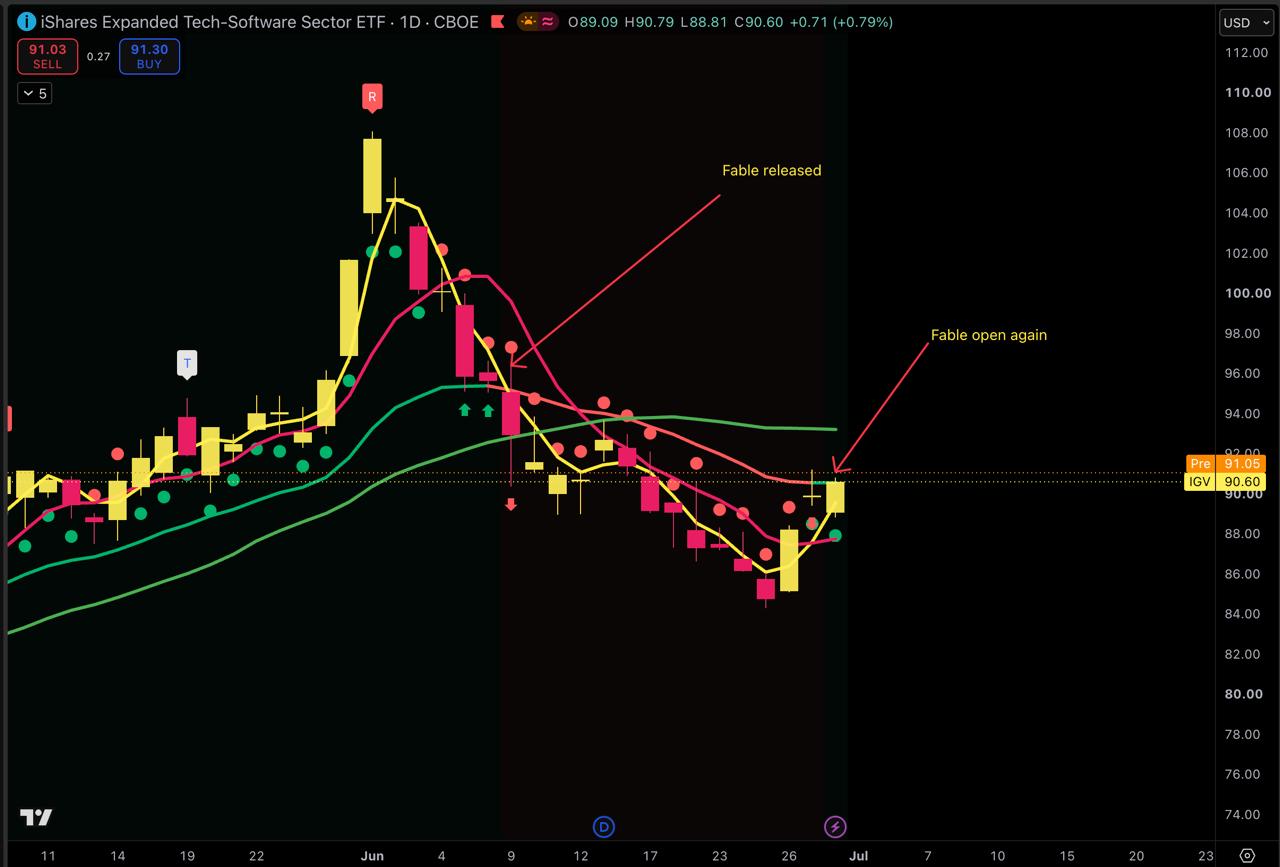
Two moments on this chart matter, and the contrast between them is the whole thesis.
The first Fable headline, early June. When the model was released, IGV was trading near its highs around 106 to 108. The reaction was textbook AI-fear selling: a sharp, sustained leg down of roughly 20 percent into the mid 80s over the following weeks. This was the old regime working exactly as it had all year.
The second Fable headline, late June. When the news broke that restrictions on Fable were being lifted, meaning wider access to an even more capable model, the market had every excuse to break to new lows. Instead, price did not flinch. IGV held its ground around the 90 to 91 area, right where it had already been basing, and even closed green. The selling that should have shown up simply did not.
That is what a character shift looks like on a chart. Same category of news, opposite reaction. When an asset stops going down on bad news, it usually means the marginal seller is done.
Why this signal matters
Markets do not bottom on good news. They bottom when bad news stops working. This is one of the oldest observations in trading, and it applies directly here.
The bearish case against software has been repeated so many times that it is now consensus: AI eats seats, AI compresses pricing, AI collapses the moat of every SaaS vendor. Anyone who wanted to sell software on that thesis has had a full year and multiple catalysts to do it. Positioning surveys and fund flows have reflected that pessimism for months.
When positioning is that one-sided, the news stops mattering and the reaction to the news becomes the signal. A market that absorbs a fresh negative catalyst without breaking is a market where supply is drying up. That is what the IGV chart is showing right now.
What would confirm the thesis
One green day is not a trend change. Here is what I want to see before treating this as a durable rotation rather than a pause:
- Price holds the base. IGV needs to defend the low 90s area where it stabilized after the June selloff. A clean break back below the late-June lows would invalidate the setup.
- A few constructive weekly closes. Daily charts show the fight; weekly closes show who won. Two or three consecutive weekly closes above the current base, ideally reclaiming the declining short-term moving averages, would confirm that demand has returned.
- Breadth inside the sector. A real rotation lifts the median software name, not just two or three index heavyweights. Watch whether beaten-down mid-cap SaaS participates.
- No fresh negative catalyst. This is the honest caveat. The thesis is that the market has priced the current state of AI capability. A genuine step-change surprise could restart the de-rating. Absent that, the path of least resistance is shifting.
The bigger picture: from narrative to fundamentals
De-rating phases end when the market stops trading a narrative and starts trading numbers again. Software fundamentals never deteriorated anywhere near as much as the multiples did. Revenue growth slowed but did not collapse, net retention held up better than feared, and many of these companies are now integrating the very AI models that were supposed to kill them, often with real margin benefit.
Meanwhile, relative valuation has swung to an extreme. Software trades at a historically wide discount to the AI infrastructure complex, where expectations, and multiples, have gone vertical. Rotations are born exactly here: crowded longs on one side, abandoned quality on the other, and a tape that has stopped punishing the abandoned side.
The bottom line
The most informative thing a market can do is ignore news it is supposed to care about. Software just ignored a headline combination, a new frontier model plus lifted restrictions, that would have knocked several percent off the sector in any month of the past year.
That does not guarantee a bottom, and it is not a signal to chase. But it does mean the risk/reward is changing. If IGV holds its base and prints a few constructive weekly closes, the setup for a rotation back into software equities improves materially. Unless a fresh negative catalyst arrives, the path toward a software rebound is opening up again.
We track setups like this on higher timeframes across the market. If you want to see how this thesis evolves in real positions, follow the Midas Index.
This article is for educational purposes only and is not financial advice.