Why Circle Could Be One of the Biggest Structural Winners of This Cycle
The market prices $CRCL like a rates trade. The SEC filings tell a different story: a future financial network hiding inside a stablecoin issuer.
Educational content only. Nothing on this page is financial or investment advice. Full disclaimer

My view is simple: the market is still underestimating how large the stablecoin opportunity can become, and Circle ($CRCL) is positioned to be one of the main beneficiaries. At today's price the stock trades like a bet on where the Fed funds rate goes next. I think it is something much bigger: an early claim on the settlement layer of internet-native money.
That gap between how Circle is priced and what Circle is becoming is the whole trade.
The market sees a rates trade. That is the opportunity
The bear case on Circle writes itself, and to be fair, the reported numbers feed it. Almost all of Circle's revenue today is reserve income: the yield earned on the treasuries and cash backing USDC. Rates go down, revenue goes down. Case closed, short-duration rates proxy, slap a discount on it.
The latest quarter even gave the bears their proof. Reserve income fell from roughly $733M in Q4 2025 to $653M in Q1 2026 as rate cuts flowed through the reserve portfolio, and total revenue dipped for the first time since the IPO.
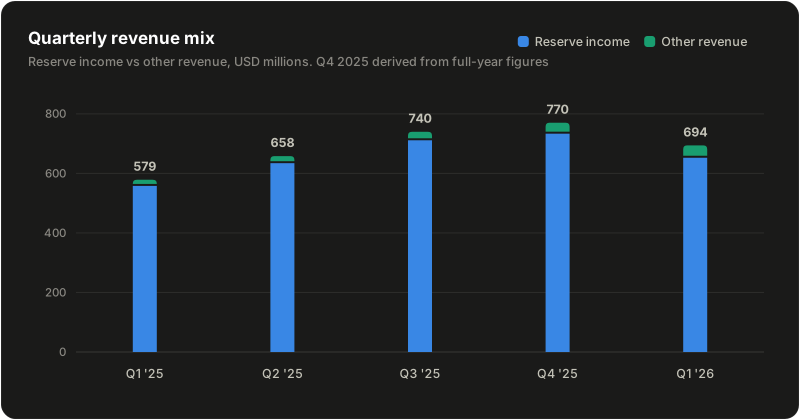
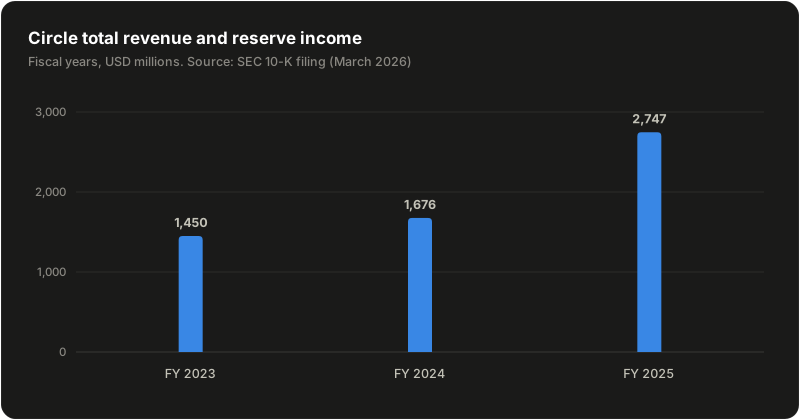
But look at what the rates framing conveniently ignores. Zoom out one level and this is a business that grew total revenue from $1.45B in 2023 to $2.75B in 2025, an 89 percent increase in two years, while USDC supply kept compounding.
And buried inside the income statement is the line that actually matters for the long-term thesis.
The network business is already showing up in the filings
Circle is not just a passive issuer collecting yield on reserves. The bigger story is the infrastructure layer they are building around USDC: their own chain, payment rails, and settlement services. If that succeeds, the business model expands materially. Circle would no longer only monetize float, it would capture value from transaction volume, payment flows, and ecosystem activity happening on top of its network.
That sounds like a story for 2028. Except the SEC filings show it starting now. Circle's non-reserve revenue, the bucket that captures everything that is not float income, exactly doubled year over year, from $20.7M in Q1 2025 to $41.6M in Q1 2026. It has grown every single quarter since the IPO, straight through the rate cuts that dented reserve income.
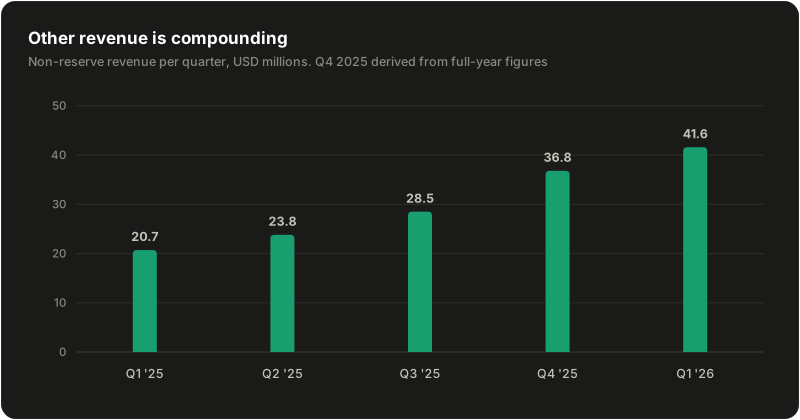
Yes, it is still small, about 6 percent of total revenue. But that is precisely the point. The market is valuing Circle on the 94 percent that is rate-sensitive and paying almost nothing for the fastest-growing line in the company, the one that represents the entire future of the business. This is what the early innings of a mix shift look like: reserve income funds the buildout, network revenue compounds underneath it, and one day the market wakes up and reprices the whole thing on a different framework.
The financial engine behind the buildout
Two more things from the 10-K deserve attention, because they answer the "can they afford this transition" question.
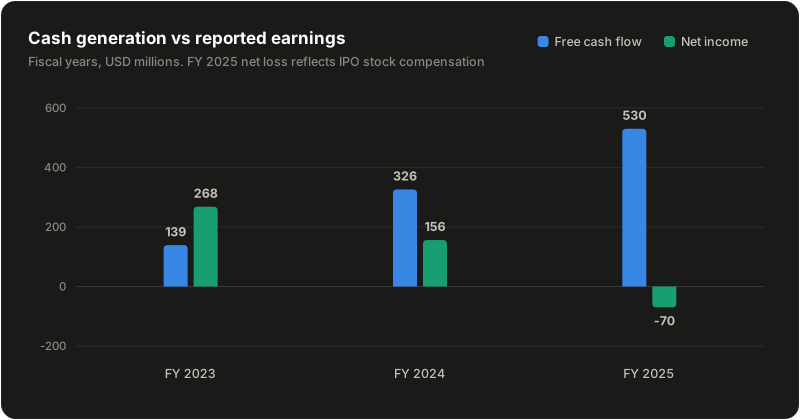
First, the reported net loss in 2025 is an accounting artifact, not a business problem. Circle lost $69.5M on paper for the year, but the entire loss traces to the Q2 2025 quarter, when the IPO triggered a massive one-time stock compensation charge. Every other quarter since going public has been profitable, and operating cash flow tells the real story: it nearly quadrupled from $139M in 2023 to roughly $530M of free cash flow in 2025.
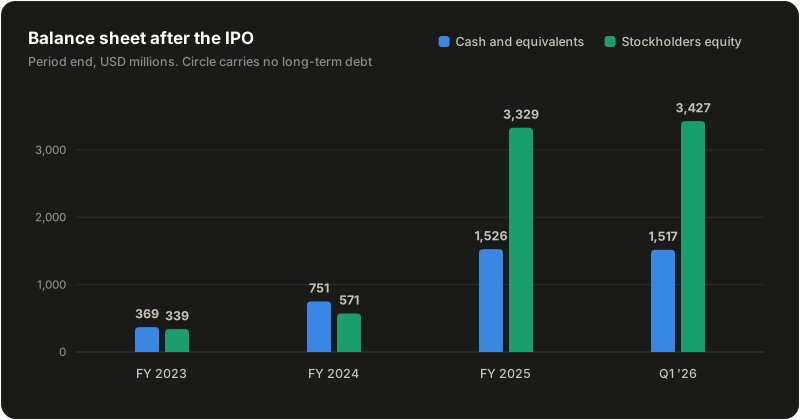
Second, the balance sheet is a fortress. Post-IPO, Circle sits on about $1.5B of corporate cash (separate from USDC reserves, which are segregated), stockholders equity of $3.4B, and no long-term debt. A company generating half a billion dollars of annual free cash flow with zero leverage can fund a chain, payment rails, and years of ecosystem incentives without ever touching the capital markets again.
The real TAM is not crypto trading pairs
Stablecoins are already core infrastructure for trading, treasury management, and on-chain liquidity. But the next leg is much larger: cross-border payments, global merchant settlement, fintech rails, and international commerce. Legacy cross-border payments are slow, expensive, and layered with intermediaries. A regulated digital dollar that settles in seconds, around the clock, at near-zero cost, is not a crypto product. It is a direct upgrade to the plumbing of global commerce.
If USDC becomes one of the default settlement assets for internet-native payments, Circle sits at the center of a massive flow business. And unlike the reserve income stream, flow revenue scales with activity, not with the Fed funds rate. That changes the valuation framework completely: you stop discounting a bond portfolio and start valuing a network.
The bank FUD is bullish
I also view the recent OUSD episode and the broader anti-stablecoin pushback from banking incumbents as a net positive for the thesis. To me, that reaction looks less like a fundamental threat to USDC and more like a sign that traditional financial players finally understand what is at stake. When incumbent banking groups start lobbying against stablecoins, it usually means the disruption is real. They are reacting because stablecoins directly challenge legacy payment rails, deposit capture, and the economics of cross-border settlement.
And here is the thing about late entrants in this market: distribution is the moat, and Circle already has it. Exchange liquidity, merchant acceptance, developer integrations, brand trust, and a regulatory position that took years to build. Banks can launch competing products, but stablecoins benefit from network effects, and network effects compound for whoever got there first. Those advantages are very hard to replicate overnight, no matter how large your balance sheet is.
The path to $160B
At roughly $64 per share, Circle's market cap sits around $17B. My base case is that if Circle establishes itself as the dominant regulated stablecoin platform and gradually migrates more activity onto its own rails, the company has a credible path toward a ~$160B market cap by the end of 2028. That is roughly 10x from current levels.
Aggressive? On a one-year view, sure. On a multi-year view, the math is less heroic than it sounds. It requires stablecoin supply to keep compounding across exchanges, payment providers, fintechs, and global merchants, USDC to hold or grow its share of the regulated segment, and the network revenue line to keep doubling the way it already is. A dominant settlement network processing trillions in annual flow does not trade at 6x revenue on a float business. It trades like financial infrastructure, and financial infrastructure at scale (Visa, Mastercard) is one of the most richly valued business models on earth.
I am not underwriting perfection. I am underwriting the market eventually moving Circle out of the "rates trade" bucket and into the "future financial network" bucket. The repricing itself is the trade.
The chart: back at the scene of the IPO
From a price-action perspective, this zone is what makes the timing interesting.
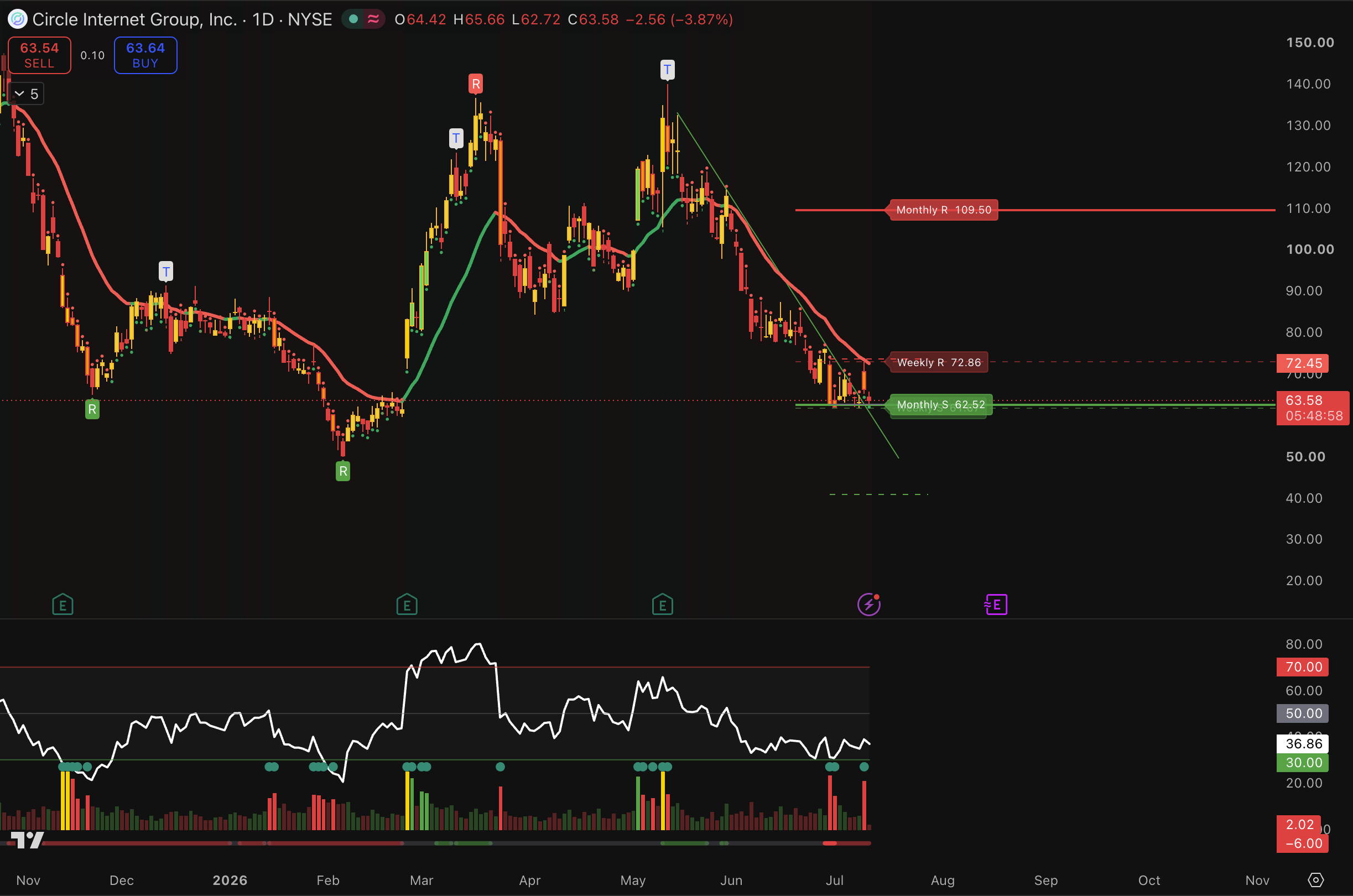
The daily chart tells a clean story:
- Price is sitting exactly on monthly support at 62.52, with the stock closing at 63.58. This is also, notably, right around the area where CRCL opened on its first day of trading. A full year of price discovery, two failed rallies toward 130-140, and the market has round-tripped the stock back to where public investors first touched it.
- The downtrend from the May high near 135 is extended. Price has fallen roughly 50 percent in two months, the daily RSI sits in the high 30s after spending weeks near oversold, and the descending trendline is starting to look exhausted rather than impulsive.
- The levels are well-defined. Above, the first hurdle is weekly resistance at 72.86; reclaiming it would break the sequence of lower highs. Beyond that there is a lot of air before monthly resistance at 109.50. Below, a decisive breakdown through the 62.5 monthly support invalidates the setup and opens the door toward the low 50s.
Asymmetric setups are born exactly here: a multi-year fundamental thesis, a stock down 50 percent from its highs, sitting on major support at the IPO reference price, with sentiment washed out by bank FUD. If the market starts to reprice Circle from a simple stablecoin issuer into a core piece of global digital dollar infrastructure, I think today's valuation will eventually look extremely cheap.
The bottom line
Circle today is priced for the business it was: a float collector whose fortunes track the Fed. The filings already show the business it is becoming: a cash-generative, debt-free network operator whose non-rate revenue is doubling annually while incumbents panic loudly enough to confirm the threat. The stock is back at its IPO opening area, on monthly support, with a defined invalidation level. That is about as clean as a long-duration entry gets.
We track setups like this on higher timeframes across the market. If you want to see how this thesis evolves in real positions, follow the Midas Index.
This article is for educational purposes only and is not financial advice. All financial figures are sourced from Circle's SEC filings (10-K filed March 2026 and quarterly 10-Q filings).